
Your NHL Fantasy Draft Cheat Sheet Should Match Your League, Not Someone Else’s
Table of Contents
Toggle
Why Most Cheat Sheets Fail Before the Draft Starts
Every September the same thing happens. Managers print off an NHL fantasy draft cheat sheet from a major site, walk into their draft feeling prepared, and spend the third round wondering why the rankings feel wrong for their league. The list says one thing. Their gut says another. Usually their gut is closer to the truth.
The problem is not that the big sites are bad at hockey analysis. The problem is that a generic NHL fantasy draft cheat sheet is built for a league that does not exist. It assumes a default scoring system, a default roster, and a default league size. Your league is not the default. Nobody’s is.
If your league counts hits and blocks, a player like Radko Gudas carries real value that a points-only ranking will never show you. If your league is points-only, that same player is barely draftable. One ranking cannot serve both managers, yet that is exactly what most cheat sheets try to do.
What a Real NHL Fantasy Draft Cheat Sheet Accounts For
A cheat sheet worth bringing to your draft accounts for three things: your scoring system, your roster configuration, and your league size. Miss any one of them and the rankings drift away from reality.
Scoring system is the obvious one. A league that awards points for shots on goal treats a volume shooter like Nathan MacKinnon differently than a league that only counts goals and assists. A categories league that includes plus-minus punishes players on bad teams in a way a points league never does.
Roster configuration is the one most managers overlook. A league with two center slots and four wing slots has a completely different scarcity picture than a league with three of each. The tenth-best center might be a starter in one format and a bench piece in another. Their real draft value changes accordingly, even though their stats do not.
League size is the third input. In a 10-team league, the replacement-level player available on waivers is genuinely good. In a 16-team league, the waiver wire is a wasteland, and roster spots become far more precious. The same player is worth more in the deeper league because his replacement is worse.
Points Leagues and Categories Leagues Rank Players Differently
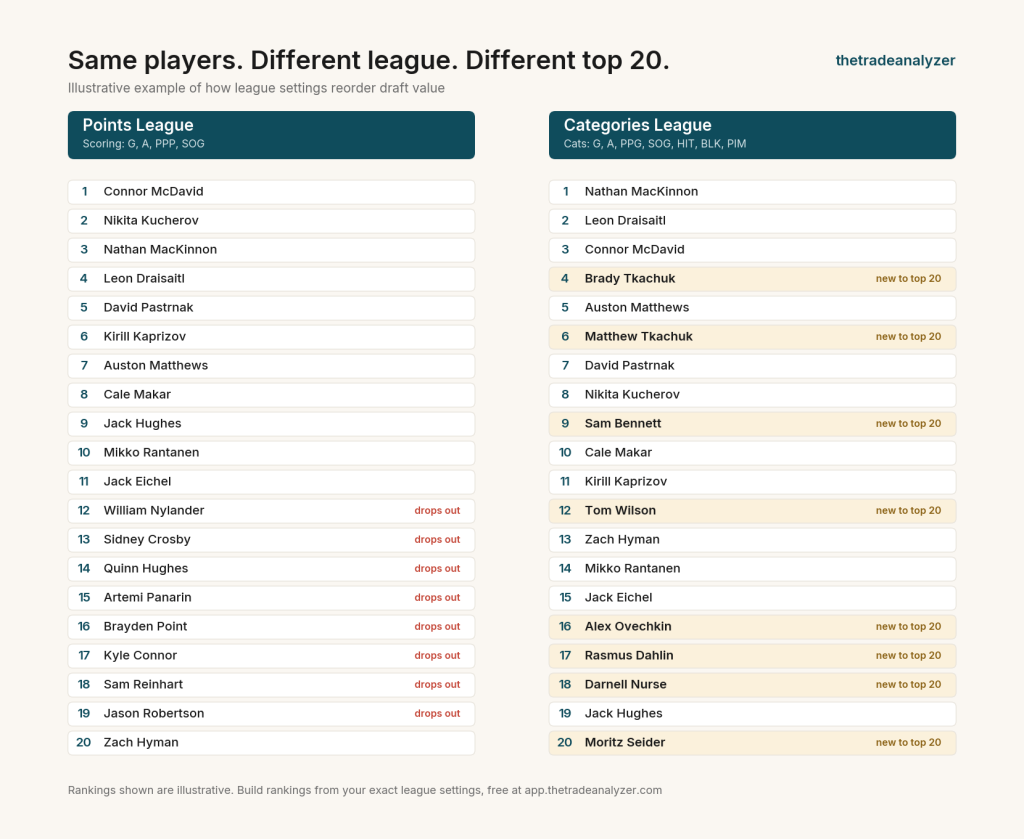
This is where a generic NHL fantasy draft cheat sheet does the most damage. Points leagues and categories leagues are close to different games.
In a points league, total production is everything. Connor McDavid and Nikita Kucherov sit at the top because they accumulate the most raw scoring output, and the list below them roughly follows total points with adjustments for peripheral stats your league counts.
In a categories league, balance matters more than totals. A player who contributes across six categories can be more valuable than a player who dominates two. Cale Makar and Quinn Hughes gain value in categories formats because elite defensemen fill scoring categories from a position where those numbers are rare. A banger who piles up hits, blocks, and penalty minutes might crack your top 100 in categories while going undrafted in points formats.
Categories leagues also reward understanding z-scores, even if you never see the math. The question is not how many goals a player scores. The question is how far above the average draftable player he is in each category your league counts, weighted by how your league counts them. That is a calculation no static cheat sheet can do for you, because the answer depends on settings only you know.
Roster Composition Changes Who Is Actually Scarce
Scarcity is relative to what your roster forces you to fill. If your league requires two goalies and only twenty goalies are worth starting, the position is tight and a top netminder like Connor Hellebuyck deserves an aggressive pick. If your league starts one goalie, you can wait several rounds and still land a quality starter.
The same logic applies to skaters. Leagues that split left wing and right wing into separate slots create positional bottlenecks that leagues with generic wing slots never experience. A right winger with dual eligibility becomes quietly more valuable in strict formats because he solves lineup problems other players cannot.
Your NHL fantasy draft cheat sheet needs to know all of this before it ranks a single player. Otherwise it is ranking players for a roster you do not have.

Build a Cheat Sheet From Your Own League Settings
This is the part that used to require a spreadsheet and a free weekend. It no longer does.
We just launched league-based player rankings in The Trade Analyzer, available to every user including free accounts. Enter your league settings, your scoring categories or point values, your roster slots, and your league size, and you get a full ranked list of players valued against your exact configuration. Not a consensus list. Not someone else’s league. Yours.
The rankings pull from live NHL data covering more than 1,000 skaters and goalies, and they recalculate against your settings. Change your league from points to categories and watch the list reorder itself. Add hits and blocks as categories and watch the physical players climb. That reordering is the entire point. It is the difference between a cheat sheet built for you and a cheat sheet built for everyone.
Creating a free account takes a minute and that is all you need to see your rankings. No payment required.

The Above Replacement Highlight, Your Edge After the Draft
The rankings come with a second layer that matters just as much after draft night as before it.
For every player, the tool highlights the specific stats where he is above replacement level based on your roster composition. Replacement level means the production you could get from the best freely available player at that position in a league your size. Anything above that line is real value. Anything below it is production you could pick up off waivers for free.
Here is why that changes your season. Say your league counts blocked shots and you are losing that category most weeks. You scan the player pool and see an undrafted defenseman sitting on waivers with blocks highlighted as above replacement in your settings. His overall ranking might be modest, but for your roster and your category needs, he is a targeted fix. Most managers would scroll right past him because the big-site rankings buried him at 180.
This works in reverse for drops. If a player on your bench is above replacement in nothing your league counts, he is a roster spot you are wasting. The highlight makes that visible at a glance instead of something you have to reason out stat by stat.
Waiver decisions are where seasons are quietly won. Draft night gets the attention, but the manager who makes twenty smart pickups between October and March usually finishes ahead of the manager who drafted well and coasted.
How to Set This Up Before Draft Night
The setup takes about five minutes. Create a free account at the app, select NHL, and enter your league settings: number of teams, roster slots by position, and your scoring format. Points leagues enter their point values. Categories leagues select their categories.
From there, your ranked player list is live. Use it as your NHL fantasy draft cheat sheet on draft night, sorted and valued for your league alone. After the draft, keep it open through the season. The above replacement highlights turn it into a running waiver wire scanner that already knows what your league rewards.
You can also run any trade offer through the analyzer using the same league settings, so the values behind your draft board and the values behind your trade grades come from one consistent system.
Generic rankings are a starting point. Your league settings are the finish line. Get a cheat sheet that knows the difference at app.thetradeanalyzer.com, and if you want saved leagues and trade history, plans start at just $2.99 a month on the pricing page at thetradeanalyzer.com/pricing.